Anyone know why I get what looks like a leaf burn on this St. Patrick hybrid tea rose? A Portland Rose Society member told me that St. Patrick doesn’t always look so great in the Portland/Vancouver area, but wasn’t so sure about why the leaves look like this every year, even before the weather gets hot. The other roses in this formal rose bed look fine.
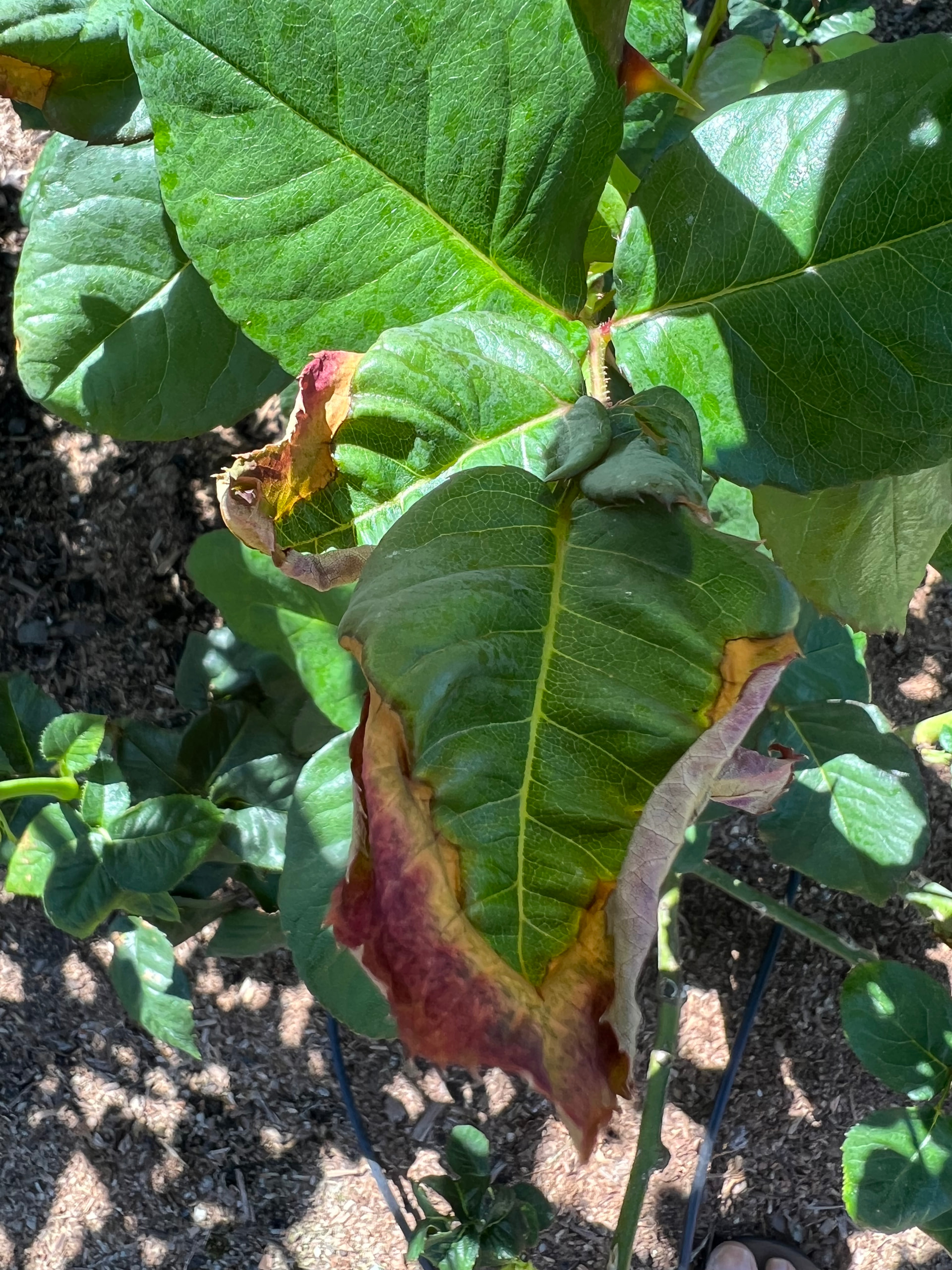
Is that plant any closer to hard scape (walls, side walks, drive way, fences, etc.) where it might receive a greater degree of reflected, radiated heat/sunlight than others in the bed? Is there a window, particularly a dual pane window, where sunlight reflects off it and is directed to the particular plant? When I lived in the Los Angeles area, there was a spot in the back yard where NOTHING would grow. There was nothing wrong with the soil and even with copious hand watering, everything planted there fried and died. It was the south west corner of the living room and the windows in that wall were bronze tinted dual panes, one story about that spot. Afternoon sunlight was focused on THAT spot and it was literally like holding a magnifying glass in a sun ray to fry whatever came into its beam. My Camry had a melted area of the plastic trim surrounding the lower edge of the windshield and no one could figure it out. Sunlight reflecting off a window in a classroom focused on THAT spot for more than an hour each afternoon, literally melting its way through the plastic.
In our current home, there is a spot to the north east of the corner of the kitchen against the fence where rose canes get scalded and foliage and blooms fry. The morning sun, rising over the neighbor’s magnolia and our Hollywood juniper in front of the side fence, reflects off the dual pane kitchen window, being focused and directed to THAT spot, as if it was passing through a magnifying glass. I have to prevent any plant I want from growing into that space or it WILL be fried, even during cool weather, as that focused, concentrated ray of sunlight is like a laser.
Are you using any kind of systemic product? Bayer 2 in 1 and 3 in 1 warn of plants being able to be burned in hotter weather. Have you researched whether the irrigation is sufficiently hitting that rose to keep it appropriately watered? Are you certain that plant’s roots aren’t picking up too much salt from the rose food and perhaps any lawn food applied to the area where its roots may grow under the turf to absorb? Knowing precisely where it sits in relation to hard surfaces, lawns, windows, etc. would help diagnose whether the issue positioning, cultural or variety related. Good luck.
Thanks for all the ideas. The only hardscape that is relatively close is a very short brick walk that surrounds the perimeter of this formal rose bed - about 1’ high. It actually is a less hot location than most of my roses, though, and it gets mostly morning sun (east facing). The other roses in that bed that border the brick wall are totally fine. Maybe this variety is more susceptible to being close to the bricks. There are no windows and no glass reflection nearby. I’m not using a systemic product on that particular rose bush. The irrigation is hitting that rose as good as the other roses in that bed and the rest are fine. It also shares the same soil. I suppose roots could grow under the formal rose bed to underneath grass turf nearby, but again, the nearby roses all seem fine. If push comes to shove, I’ll try changing its location in the fall - maybe even put it in a pot where I can monitor things closely.
Thanks, again, for the ideas.
2 Likes
You’re welcome. I hope moving it helps.
1 Like